

Which Businesses Will Benefit Most from AI Search?
Which Businesses Will Benefit Most from AI Search?
Which Industries Benefit Most from AI Search Right Now?
Not every industry stands to gain the same amount from the shift to AI search. Some businesses are built for it. Others barely register.
The businesses pulling ahead are the ones that solve a specific, high stakes problem for the person asking. A tool that needs fixing, a body that needs treating, a decision that needs professional advice. AI search rewards trust and clarity, not browsing and impulse.
That is the line separating winners from bystanders in this shift, and it is worth 150 words of explaining before diving into who actually benefits.
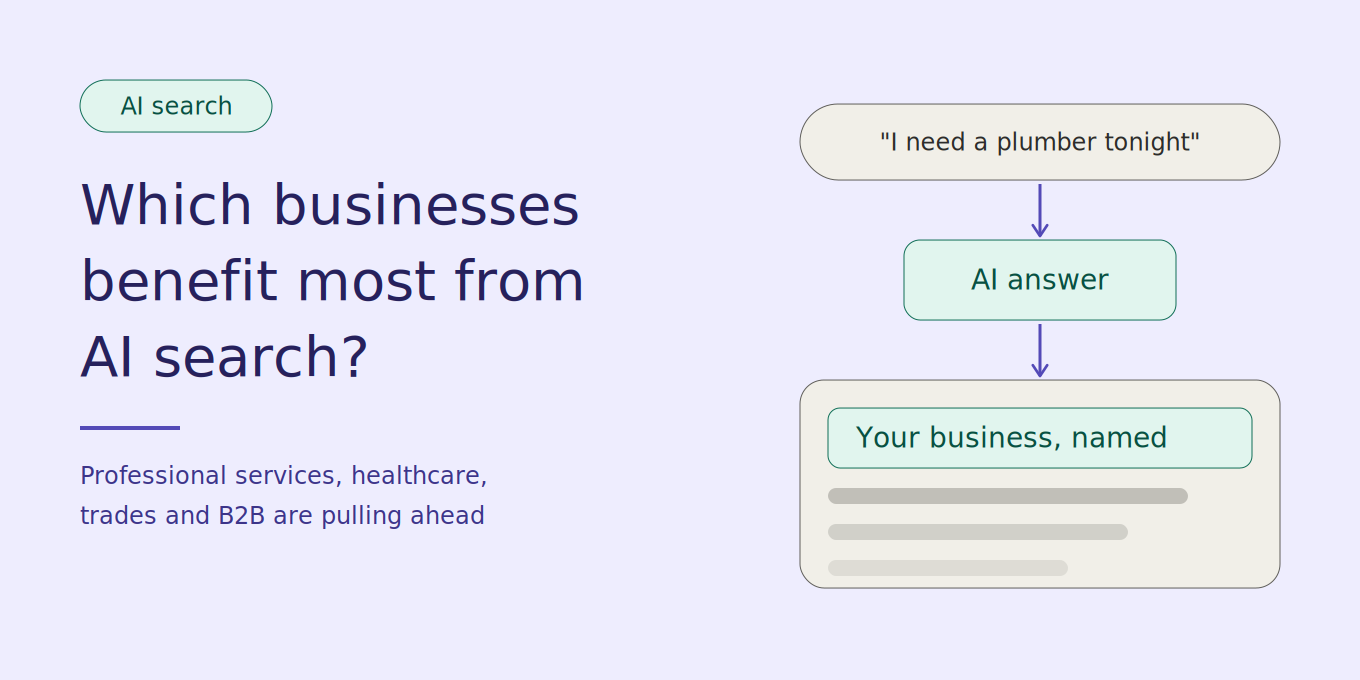
AI tools such as ChatGPT, Gemini and Google's AI Overviews are built to answer a question and hand over a recommendation in the same breath. This works best when a person is asking "I need a plumber who can fix a burst pipe tonight" rather than "show me some plumbing options I could look through." The first is a problem statement. The second is a browsing session. Generative AI is trained to resolve problems, not to replace the endless scroll of a marketplace or a catalogue. Research from Australia's Fifth Quadrant found generative AI is increasingly chosen as a first option for tasks involving interpretation, complexity or competing choices. At the same time, traditional search engines still win for quick, transactional look-ups. Professional services, healthcare, trades and business services all sit squarely in that first category, which is exactly why they stand to benefit the most.
Why Problem Solving Industries Win the Most From AI Search
Businesses that solve a defined problem for a defined person are the ones AI search engines are built to reward, because these tools are trained to answer questions, not to showcase products. This section explains why trust based, problem first industries are pulling ahead while low-intent, browsing-heavy categories are being left behind.
AI search does not behave like a search engine results page filled with ten blue links and a scroll bar. It behaves more like a knowledgeable friend who gives a direct, confident answer and, increasingly, a business name to go with it. That only works when the underlying task has a right answer, and professional services, healthcare and trades all have exactly that. A person asking an AI tool about a burst pipe, a tax return or a sore back wants a resolution, not ten open tabs. According to Fifth Quadrant's Consumer Sentiment Tracker, Australians are increasingly turning to generative AI for explanation, comparison and decision support in areas involving work, health and financial topics, precisely the domains where professional services and trades operate.
Is AI Search Actually Changing How People Choose a Professional or Tradie?
Yes, and the shift is measurable. Roughly 64% of Australians have seen an AI Overview appear in their search results, and AI tools are increasingly the entry point for exactly the kind of "I need help now" queries that professional services and trades rely on for new business.
The number of Australians naming an AI tool as their main way of finding information online has more than doubled in a year, from around 5% to about 12%, according to Telsyte's tracking cited in recent Australian search research. That is still a minority of searches overall, but it is growing from a standing start, and it is growing fastest in exactly the categories this article covers: problems that need a trusted, qualified answer rather than a product to compare.
Which Industries Are Best Positioned to Benefit From AI Search?
The industries best placed to benefit share three traits: the customer has a genuine problem, the solution requires trust or licensing, and the search happens with urgency or high stakes attached. Professional services, healthcare, trades and business-to-business services all meet this criteria consistently.
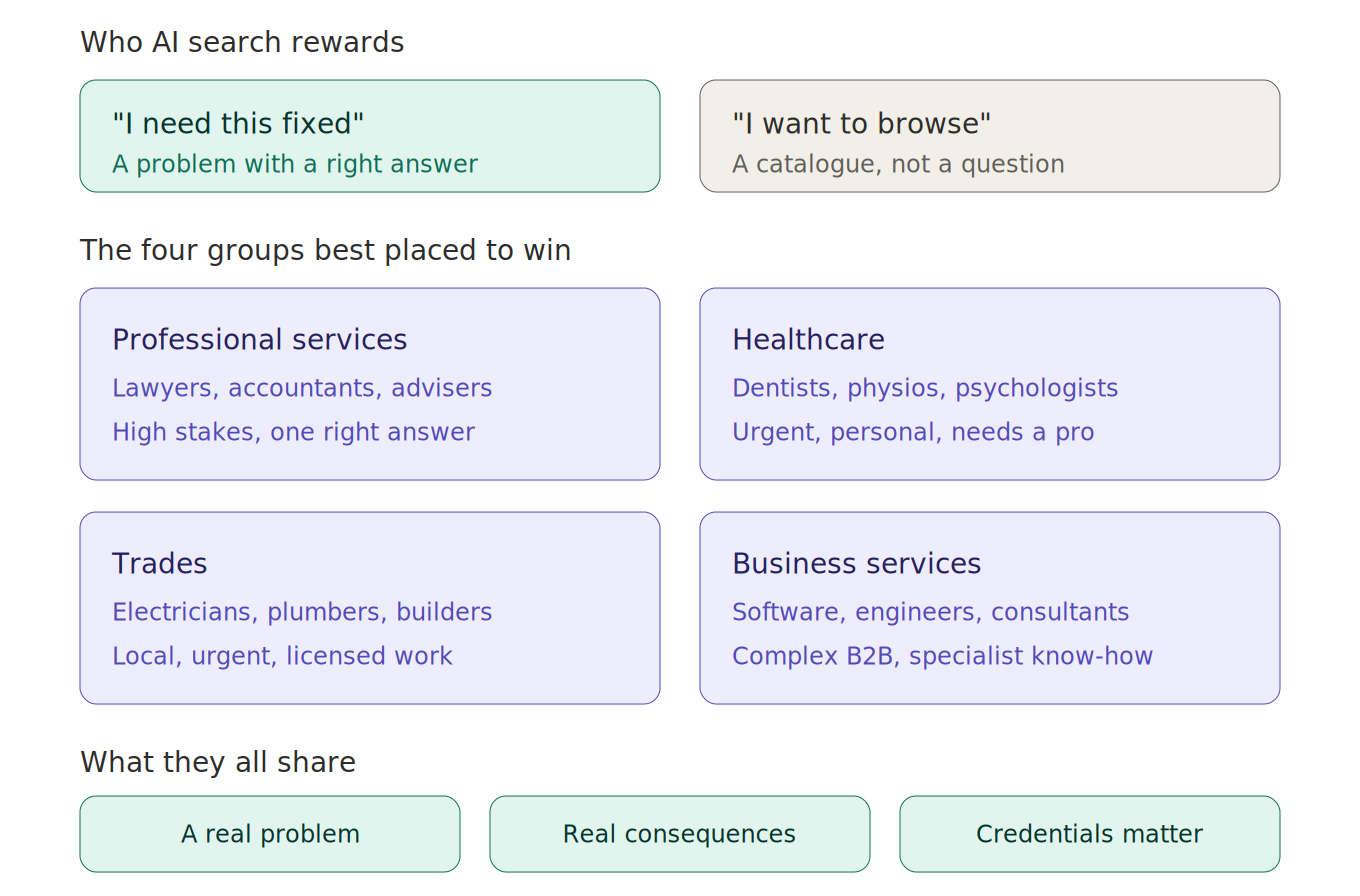
What Do These Industries Have in Common?
Each of these industries answers a question that starts with "I need" rather than "I want to browse," and that single distinction is what determines how well a business performs in an AI-driven search result.
- The customer has an actual problem, not a preference to explore
- A wrong choice carries real consequences, financial, legal or physical
- Licensing, qualifications or credentials matter to the outcome
- The purchase decision tends to happen once the problem is confirmed, not before
People Also Ask
Do AI search tools favour big brands over small local businesses? Not automatically. AI tools tend to favour clear, well-structured information and demonstrated expertise over sheer brand size, which gives smaller specialist firms a genuine opening.
How is AI search different from paid search ads for these industries? AI search answers are generated from content and authority signals rather than bids, so a strong content and reputation strategy matters more than ad spend alone.
How Professional Services Can Capture More AI-Driven Enquiries
Lawyers, accountants and financial advisers are among the biggest winners from AI search because clients researching these services want a confident, qualified answer to a specific problem before they ever pick up the phone. Building visible expertise online is now central to being that answer.
Trust plays an outsized role in professional services, arguably more than in any other category on this list. Trust in the financial services sector globally has been on a steady, measurable climb, up around 10 points over five years according to Edelman's global Trust Barometer research, and Australia's own broader trust score in business, government, media and NGOs moved from a distrust rating in 2025 to a neutral rating in 2026. That shift matters because AI tools are, in effect, trust filters. They are trained to surface sources that read as credible, well organised and specific, which rewards firms that publish clear, plain English guidance rather than generic marketing copy.
How Should a Law Firm or Accounting Practice Structure Content for AI Search?
Content should answer the exact question a client would type, using plain language, specific examples and a clear conclusion, because AI tools extract and summarise structured answers far more reliably than they extract vague, promotional pages.
Firms that publish direct answers to real client questions, backed by genuine expertise, are the ones AI tools are most likely to reference and recommend.
What Content Formats Work Best for Professional Services?
- Clear FAQ pages answering specific client questions in plain English
- Case studies with real, anonymised outcomes and numbers
- Explainer articles that answer "how much does X cost" or "how long does X take"
- Author bios that establish real, checkable credentials
People Also Ask
What is the average cost of getting a financial adviser in Australia? Costs vary widely by service type, but ongoing advice commonly runs from a few thousand dollars a year, so most firms benefit from publishing a clear, upfront pricing guide.
Can AI tools recommend a lawyer or accountant by name? Yes, AI tools increasingly cite specific firms and professionals when the underlying content clearly demonstrates expertise and answers the question directly.
Why Healthcare and Trades See the Fastest AI Search Gains
Dentists, physiotherapists, psychologists, electricians, plumbers, builders and similar trades benefit fastest from AI search because their customers are usually searching under real time pressure with a genuine, immediate problem, which is exactly the scenario AI tools are optimised to resolve quickly and confidently.
Urgency changes search behaviour completely. A person with a toothache, a leaking roof or a tripped circuit is not comparing five options for fun; they want the fastest path to a qualified, available provider. AI tools are increasingly used for this kind of decision support because they can combine location, urgency and credibility signals into one direct answer, rather than making the person sift through a results page. This is precisely the "I need" behaviour that separates AI search winners from businesses built around slower, browsing-based decisions.
Why Do Emergency and Licensed Trades Perform Especially Well in AI Search?
Emergency and licensed trades perform well because urgency plus licensing removes ambiguity from the decision, and AI tools are built to give one confident, specific answer rather than a list of loosely ranked options.
A burst pipe or a lost filling does not leave room for browsing, so a business that is clearly qualified, locally relevant and easy for AI tools to reference gets chosen fast.
What Makes a Trade or Healthcare Business Easy for AI Tools to Recommend?
- Clear service area and licensing details stated plainly on the website
- Genuine reviews and testimonials that mention specific outcomes
- Fast-loading, mobile friendly pages with straightforward contact details
- Content answering common problem specific questions, not just service lists
For local service providers, this shift explains why local tradies dominate AI search recommendations when urgency and trust intersect.
People Also Ask
Do online reviews influence AI search recommendations for tradies and healthcare providers? Yes, review volume and sentiment are commonly used as trust signals, so businesses with consistent, genuine reviews tend to be referenced more often.
Is AI search replacing directories like Google Maps for finding a tradie? Not yet, but AI tools increasingly draw on the same underlying data, so a strong, accurate Google Business Profile still matters for AI visibility.
How B2B and Business Services Firms Can Win in AI Search
Software companies, manufacturers, engineers and consultants benefit from AI search because B2B buyers now use these tools heavily during research, using AI to shortlist, compare and validate specialist providers before a human sales conversation ever begins.
B2B decisions are rarely made on impulse and usually involve more than one person weighing up risk. That research-heavy behaviour lines up closely with how generative AI is actually used. Fifth Quadrant's research found AI is increasingly the first choice channel for tasks involving complexity, uncertainty or competing options, a near-perfect description of enterprise software selection, manufacturing partner vetting or engineering consultancy shortlisting. A business that has published deep, specific, well structured content about its exact specialism has a real chance of being the answer an AI tool gives a buyer at the shortlisting stage.
How Are B2B Buyers Actually Using AI Tools During the Research Phase?
B2B buyers are using AI tools to summarise vendor capabilities, compare technical specifications and shortlist providers before ever visiting an individual company website, which means the buyer's first real impression of a firm often now happens inside an AI generated summary.
This makes structured, specific and well sourced technical content a genuine sales asset rather than just a marketing nicety.
What Should B2B and Business Services Firms Publish to Be AI Search Ready?
- Detailed technical documentation and specification pages.
- Comparison content that honestly addresses alternatives, not just self-promotion.
- Case studies with measurable, specific results and clear industry context.
- Clear "who we work with" and "how we work" pages that AI tools can summarise accurately.
This makes structured, specific and well-sourced technical content a genuine sales asset rather than just a marketing nicety. Understanding how buyers research inside these interfaces reveals why traditional site traffic is giving way to the great website bypass during the early shortlisting phase.
People Also Ask
Does AI search change how long the B2B sales cycle takes? It can shorten the early research stage significantly, since much of the shortlisting now happens before a buyer contacts a sales team directly.
Are AI tools reliable for comparing technical specifications between manufacturers or software vendors? They are useful for a first pass, but buyers still verify technical claims directly with vendors, which keeps accurate published documentation essential.
So What Should a Business in These Industries Do Next?
The businesses winning in AI search are not the loudest or the biggest. They are the ones that answer real questions clearly, back their claims with genuine expertise, and make it easy for both people and AI tools to trust them. Professional services, healthcare, trades and business services all sit in a strong position, but only if the underlying content actually does the work of answering, not just advertising.
"When an AI tool answers on your behalf, is it telling your story accurately, or someone else's version of it?"
The businesses that win the next decade of search won't be the ones with the biggest ad budget. They'll be the ones AI trusts enough to speak for.
Getting found by AI search is not something that happens by accident. It takes a deliberate content strategy built around real client questions, genuine expertise and structure that both people and AI tools can actually read. This is exactly the kind of work B2B Websites does for professional services, healthcare, trades and business-to-business clients across Australia, turning existing expertise into content that AI tools want to cite.
For more insights like this, the B2B Websites media hub carries a growing library of articles built to help forward-thinking businesses stay ahead of the shift to AI-driven search, exploring key topics such as what makes the AI revolution fundamentally different for modern enterprises.
Frequently Asked Questions
How much does it cost to optimise a website for AI search? Costs vary by business size and existing content, but most engagements start with a content and technical audit before scoping ongoing work.
How long does it take to start appearing in AI search results? Some businesses see early citations within weeks of publishing strong, structured content, though consistent visibility typically builds over several months.
Is AI search optimisation different from traditional SEO? They overlap significantly, but AI search places more weight on clear, direct answers and demonstrated expertise than on keyword density alone.
Can a small trades or professional services business compete with larger firms in AI search? Yes, AI tools favour clarity and credibility over size, which gives well-structured smaller firms a genuine opportunity to be cited alongside or ahead of bigger competitors.
What is the first step a business should take to improve its AI search visibility? Start by auditing existing content against the real questions customers ask, then rebuild key pages to answer those questions directly and clearly. If you want expert guidance, B2B Websites can conduct a full AI audit and handle the restructuring for you.
Should a business hire an agency or handle AI search optimisation in-house? It depends on internal resourcing and expertise, though many businesses find a specialist agency delivers faster, more consistent results than building the capability from scratch.








%2520-%2520Main%2520Image.jpeg)
Versatility Across All Platforms


How can i help you today?


