

Does Prompt Length Matter?
Why AI Rewards Better Questions, Not Just Longer Ones
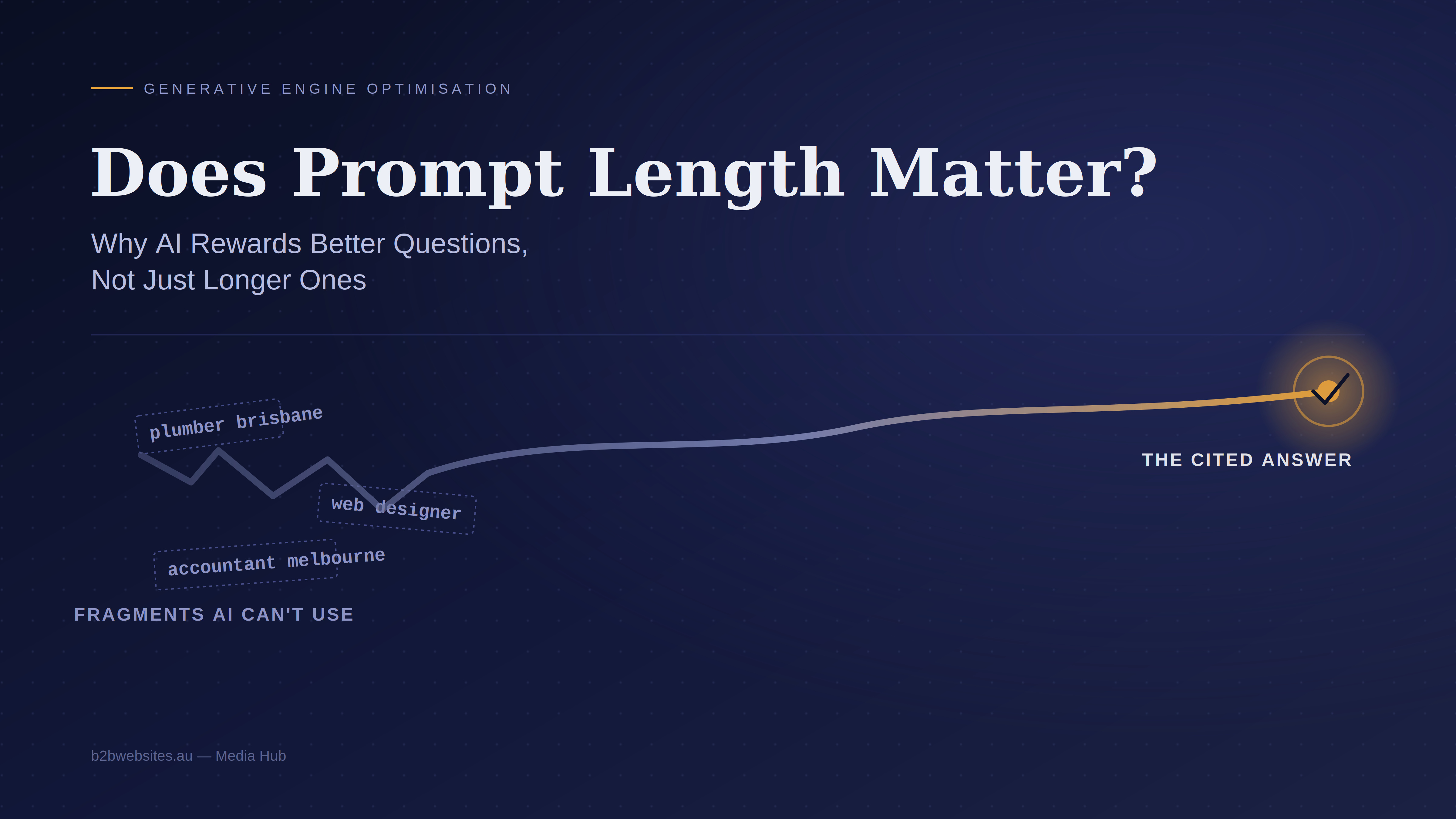
For years, businesses were told to optimise for short, clipped keywords such as "plumber Brisbane", "accountant Melbourne" or "web designer". That approach made sense back when search engines only matched exact keywords to a page. Today, people are typing questions like "Who is the best commercial plumber in Brisbane experienced with schools and hospitals?" or describing a real situation, such as a leaking tiled roof after heavy rain in North Brisbane, and asking whether it should be repaired or replaced. These are no longer keywords. They are conversations, and AI systems are built to respond to conversations, not fragments.
AI rewards detailed, well formed questions because large language models are trained to interpret intent, context, and nuance rather than to match isolated terms. A short prompt like "plumber Brisbane" gives an AI system almost nothing to work with beyond a location and a trade. A longer, specific prompt that names the problem, the setting, and the constraints gives the model enough context to reason through the query and produce a genuinely useful answer. This is why length alone is not the goal. A rambling 80 word prompt with no clear intent will confuse an AI system just as easily as a two word search once did. What matters is precision, context, and structure working together, which is exactly what businesses now need to reflect in the content they publish if they want to be the source an AI system chooses to cite.
From Keywords to Conversations: How Australian Search Behaviour Has Changed
Australians have moved from typing short keyword fragments to asking AI tools full, natural language questions, and this shift is already reshaping how content gets discovered. Roy Morgan, a leading Australian market research firm, found that 58 percent of Australians aged 14 and over now use AI tools such as ChatGPT, Gemini or Copilot in an average four-week period. That is not a niche behaviour anymore. It is closer to how Australians once treated a search engine or a messaging app.
The way people phrase those interactions has changed just as much as how often they use them. Search behaviour research covering Google's AI Mode found that the average AI search query now runs roughly three times longer than a traditional typed search, as people shift from keyword shorthand into genuine, full sentence questions. Voice search data tells a similar story, with conversational voice queries frequently running into the twenty word range, compared with just four to six words for a typed keyword search. Businesses that still write content around short, clipped phrases are effectively speaking a different language to the one their customers are now using to find them.
What Is Generative Engine Optimisation and How Is It Different From SEO?
Generative engine optimisation, often shortened to GEO, is the practice of structuring content so AI systems such as ChatGPT, Gemini and Perplexity can understand it, trust it and cite it directly in an answer. Traditional SEO focused on ranking a page in a list of ten blue links. GEO focuses on becoming the actual answer, or the source behind it. The two disciplines overlap heavily, since both reward clear structure, credible sourcing and genuine expertise, but GEO places far more weight on being quotable in a single, self contained passage.
How Much of Australian Search Traffic Now Involves AI?
Australian internet behaviour research from roi.com.au found that 64 percent of Australian internet users have encountered a Google AI Overview, the AI-generated summary that now appears above the traditional search results. The same research found that 65 percent of Google searches in Australia now end without a click, and that figure rises to 83 percent when an AI Overview is present on the page. For businesses relying on informational content to drive website visits, this is a meaningful shift in where the value of a search actually lands.
Signs a Business Is Losing Visibility to AI Search
- Website traffic from informational blog content is falling even though rankings look stable.
- Branded search volume is steady, but click-through rates on non-branded terms are declining.
- Competitors are being named directly inside ChatGPT or Gemini answers, but the business is not.
- Content still reads like a keyword list rather than a direct answer to a real question.
This behavior was extensively discussed in our deep dive into The Great Website Bypass, which explores how these zero click habits change how businesses must position themselves to get chosen.
People Also Ask
Is voice search the same thing as AI search? Not exactly. Voice search is one method of asking a question aloud, while AI search refers to the underlying system, such as ChatGPT or Google's AI Mode, that interprets and answers the question, whether it was typed or spoken.
Do AI Overviews appear for every type of search in Australia? No. AI Overviews are more common for informational, how-to, and comparison-style questions, and far less common for highly transactional searches such as direct product purchases or bookings.
Example: A business owner searching "best accounting software for a small trades business in Australia" is far more likely to see an AI Overview than someone searching "buy MYOB licence online".
Length Isn't the Point: What Actually Makes a Prompt Better
A longer prompt only produces a better AI answer when the extra length adds genuine context, not when it simply adds more words. A well constructed question defines the problem clearly, states any relevant constraints, and gives the AI system enough detail to reason through a specific situation rather than a generic category. This is precisely why "leaking tiled roof after heavy rain in North Brisbane, repair or replace" produces a far more useful response than "roofer Brisbane", even though the difference is really about clarity rather than character count.
This same principle now applies directly to how businesses should write their own content. A blog post or service page stuffed with keyword repetition offers an AI system no more clarity than a short, vague one does. What earns a citation is content that reads like a considered, specific answer to a specific problem, written the way a knowledgeable person would actually explain it to a client standing in front of them.
How Long Should an AI Prompt Be?
An AI prompt should only be as long as it takes to give the system clear context, constraints, and a specific goal; there is no magic word count. A prompt that names the exact problem, the location, the constraints, and the desired outcome will consistently produce a more useful answer than a vague prompt of similar or even greater length. By focusing on precision over volume, you eliminate the guesswork for the AI system, resulting in a much sharper response.
Does a Longer Prompt Hurt the Answer?
Yes, a longer prompt absolutely hurts the answer if the extra words don't add real context. AI requires clear, specific context to deliver its best possible response, so when you give the system a rambling paragraph that never states the actual problem, you simply give it more text to interpret without any added clarity. This forces the system to guess at what matters, which produces a generic or partially relevant response regardless of how detailed the prompt appears on the surface. Specificity, not volume, is what drives a sharper result.
Elements of a High Quality, AI Friendly Question
- A clearly stated problem or goal, not just a topic or category.
- Relevant context, such as location, industry or timeframe.
- Any constraints that matter, such as budget, urgency or prior attempts.
- A clear indication of the kind of answer being sought, such as a comparison, a recommendation or a step-by-step process.
People Also Ask
Does the ideal prompt length change depending on the AI tool you use? No. While ChatGPT, Gemini, and Claude have different maximum character limits, they all follow the same rule: precision beats volume. Regardless of the platform, accuracy always depends on clear context, not word count.
Can businesses see which questions AI tools are already answering about their industry? Yes. You can easily test your brand's AI visibility by running a manual audit. Here is how to do it:
- Open a private session: Open a clean, incognito browser window so your past search history does not bias the results.
- Test real customer questions: Type specific phrases, such as "best accountant for a sole trader in Melbourne who works with tradies", directly into ChatGPT, Gemini, or Perplexity.
- Analyse the recommendations: Look at which competitors the AI recommends and check the sources it lists to see exactly where it is getting its information.
How to Get Cited by AI Search Engines: Content Structure for Businesses
Businesses earn AI citations by writing content that answers a specific, realistic question directly within the first sentence or two of a section, then supporting that answer with clear structure such as headings, tables, and short lists. AI systems are built to extract concise, self-contained answers, so content buried in long, meandering paragraphs is far less likely to be selected than content that states its answer plainly before expanding on the detail.
This shift marks a complete transition away from traditional SEO and toward what is now being called AI citation optimisation or LLM (Large Language Model) optimisation.
Instead of creating pages targeting short, clipped keywords like:
- Business startup checklist
- How to register a business
- Start a company in Australia
The strategy now is to create entire pages that answer complete human questions exactly as someone would type them into ChatGPT, Gemini, Claude, or Perplexity. For example, instead of optimising a page for the generic term "Business Registration", a business might build an entire page titled:
"What are all the things I need to do before launching my first business in Australia if I have never owned a business before?"
Why does this approach work so well? LLMs don't search exactly like Google. They actively look for content that answers a question completely. If your page becomes one of the best answers available on the web, AI search engines begin citing it. It isn't doing this because of a high volume of backlinks alone; it is doing it because the content is genuinely useful and directly matches the conversational depth of the prompt.
This has a direct commercial impact. Research from fruitfulonline.com.au found that brands cited directly inside AI-generated answers earn roughly 120 per cent more clicks than those that are not, and separate PayPal research found that 48 per cent of Australians have already used AI assistants during online shopping, rising to 66 per cent among under-45s. Being the answer, rather than simply being listed, is quickly becoming the more valuable position to hold.
How Should a Business Format a Web Page So AI Tools Can Cite It?
A business should open each key section of a page with a direct, self contained answer of roughly forty to sixty words, written in plain language, before adding supporting detail underneath. This mirrors exactly how AI systems extract and quote content, since a clear answer positioned at the top of a section is far easier for a language model to lift cleanly into a generated response than an answer scattered across several paragraphs.
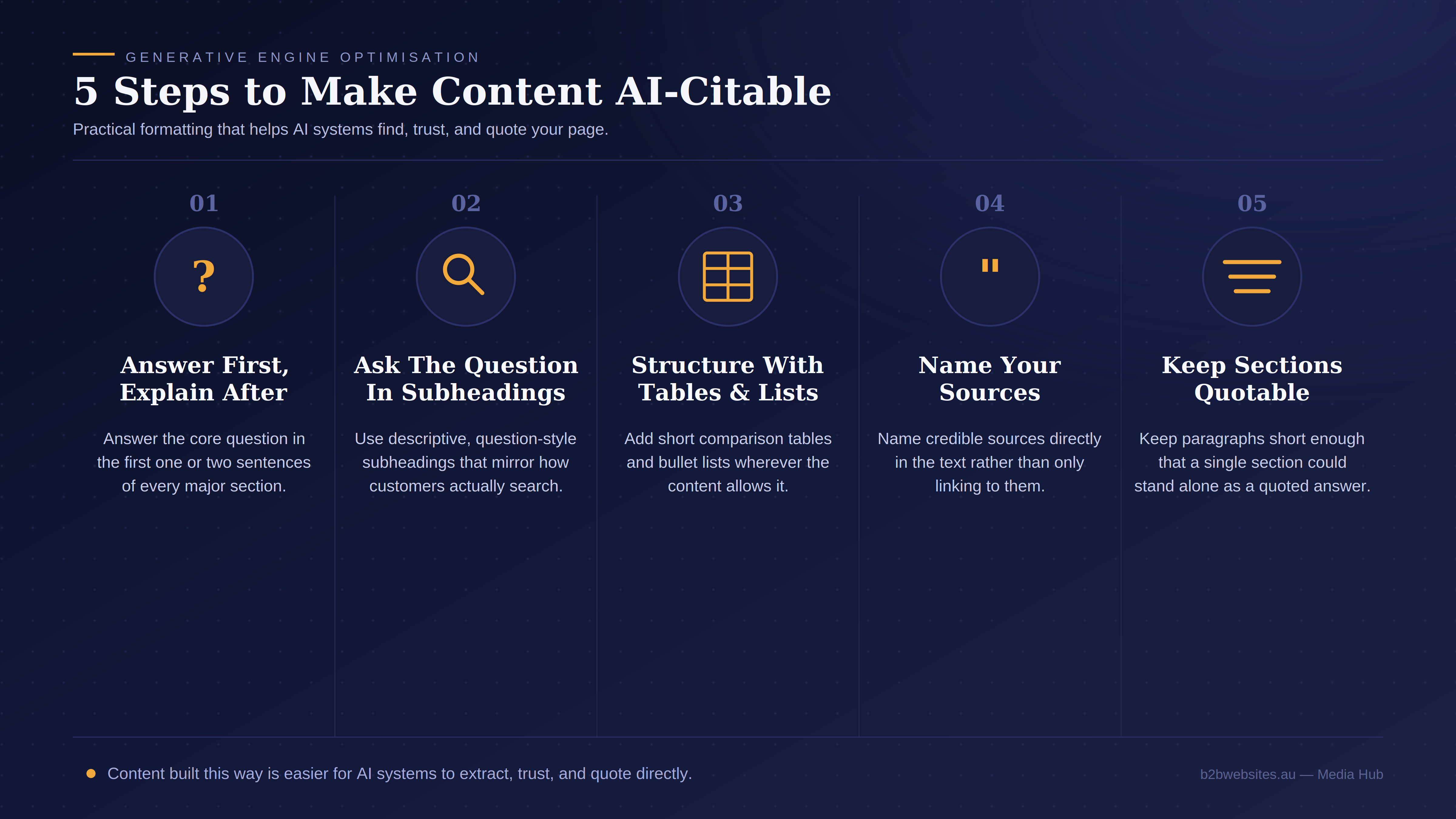
This simple formatting choice is actually the very first step toward preparing a digital footprint for modern search engines. Then, take a deep dive into whether your website is operating at different levels of AI readiness, which breaks down this structural hierarchy and examines how foundational clarity unlocks higher levels of visibility.
People Also Ask
Do AI systems prefer content from well known brands over smaller businesses? Not necessarily. AI systems weigh clarity, structure, and demonstrated expertise heavily, which means a smaller business with precisely structured, genuinely useful content can be cited ahead of a larger competitor with vaguer, less structured pages.
How often should a business update its content to stay visible in AI search? Reviewing key service pages and blog content every three to six months is a reasonable baseline, since AI systems favour content that reflects current data, pricing and industry conditions over content that has clearly gone stale.
Example: A Perth interior design studio that rewrites its "cost of a kitchen renovation in Perth" page every quarter with updated pricing is more likely to be cited than a competitor with a similar page last updated two years ago.
So What Does This Mean for the Way Businesses Should Write?
The businesses that adapt fastest will not be the ones writing the longest content or stuffing pages with keywords. They will be the ones that learn to answer real questions the way a trusted expert would, clearly, specifically, and without unnecessary padding. That same principle applies just as much to how a business prompts an AI tool internally as it does to how a business writes for its own customers. A precise question or a precise piece of content beats a long, vague one every time.
As AI search continues to absorb a growing share of how Australians research services, compare providers and make decisions, the businesses that treat every page as a direct, honest answer to a real customer question will be the ones AI systems reach for first.
So the real question worth asking is not how long a prompt, or a page, needs to be. It is whether it says something specific enough that an AI system, and a real customer, would actually trust it.
The next era of visibility will not belong to the businesses that write the most. It will belong to the ones that answer the best.
Shifting your operations to meet these standards requires an understanding of how both your internal software and your public content align with modern data requirements. In our media hub designed to help business owners streamline their workflows, you will find the answers. If you want to see how these automated systems work in practice, read our breakdown of how modern platforms use APIs to connect data and automate inventory to cut down on daily admin work.
If you're looking for a digital solution that's built for today's search engines and tomorrow's AI, discover how B2B Websites create custom, AI ready websites designed to support long-term business growth.
Frequently Asked Questions
What is the ideal length for a prompt when using an AI tool like ChatGPT? There is no fixed ideal length. The prompt should be as long as it needs to be to include the real context, constraints, and goal, and no longer.
How much does it cost a business to optimise its website for AI search? Costs vary depending on the size of the website and the extent of the restructuring required, but most businesses start with a content audit before investing in a full generative engine optimisation strategy. To see where your site stands, you can request an obligation free AI audit to identify exactly what needs updating before investing in a full strategy.
Can a business use ChatGPT itself to check if it is being cited? Yes. Asking ChatGPT, Gemini, or Perplexity realistic customer questions about a business's industry and location is a simple, free way to see whether that business currently appears in AI generated answers.
Does Google AI Overview replace the need for traditional SEO? No. Traditional SEO fundamentals such as page speed, mobile usability, and quality backlinks still matter, but they now need to be paired with content structured for direct extraction by AI systems.
How long does it typically take to see results from generative engine optimisation? Most businesses begin seeing measurable changes in AI citations and referral traffic within three to six months of restructuring key content, though timelines vary by industry and competition.
Is it worth hiring an agency to manage AI search visibility, or can it be done in-house? It depends on internal resourcing and expertise. Businesses with existing content teams can often manage the shift with the right training. At the same time, those without dedicated resources typically see faster, more consistent results by partnering with a specialist like B2B Websites for AI ready website development, building a foundation that functions properly right out of the box.










%2520-%2520Main%2520Image.jpeg)
Versatility Across All Platforms


How can i help you today?


