

Is AI-Readiness Really One Thing, or Is Your Website Operating at Different Levels?
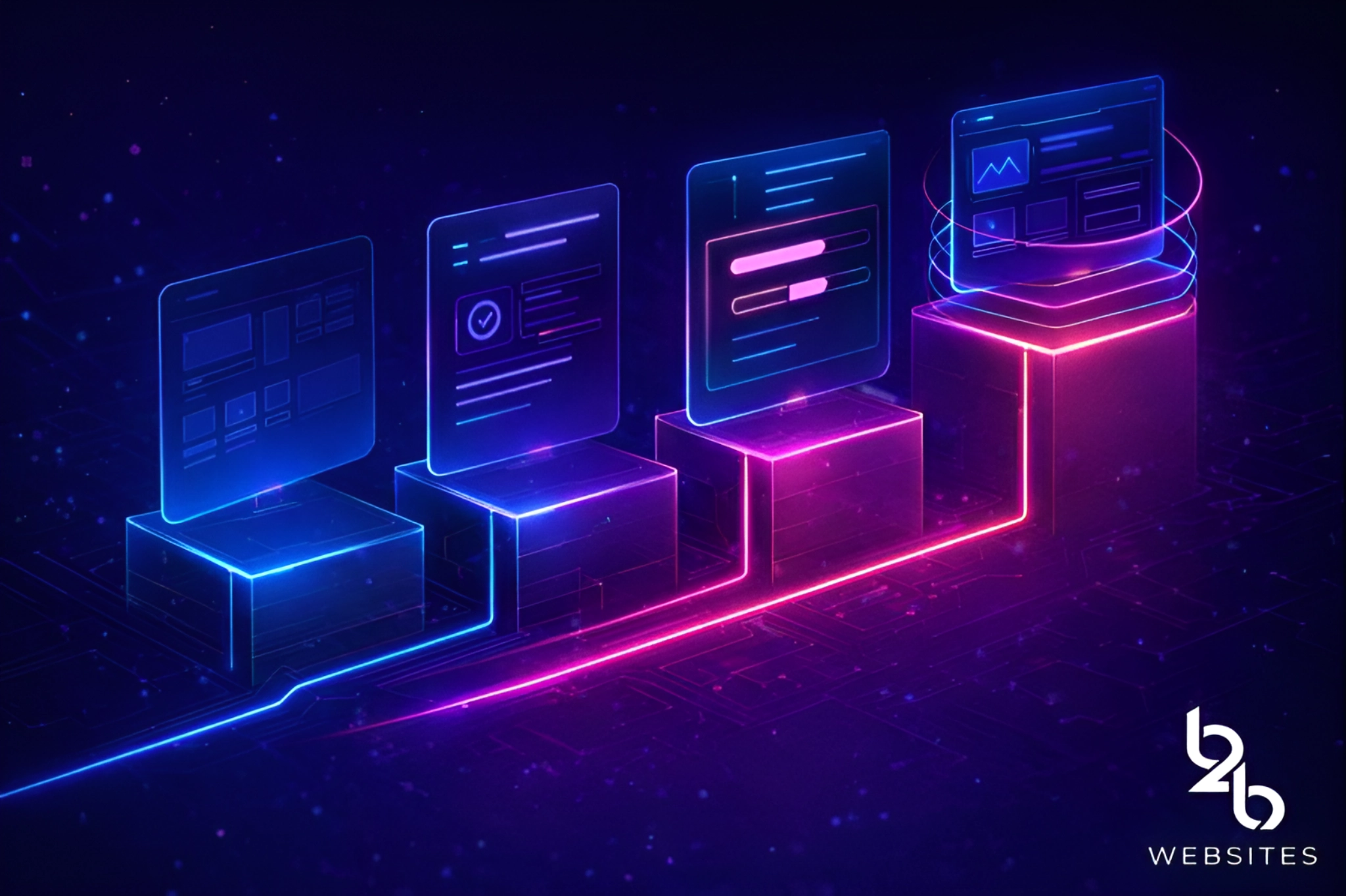
AI-readiness is not a single state that a website either has or lacks. It is a progression of capability that determines how well artificial intelligence systems can understand, trust, and recommend your business. When businesses ask whether their website is AI-ready, they are often oversimplifying a far more layered reality. AI evaluates websites in stages, not in absolutes. Each stage answers a different question, and failure at any stage limits how far your website can go in AI-driven discovery.
Rather than asking if your website is AI-ready, the more accurate question is what level of AI-readiness it currently operates at. AI systems assess clarity first, credibility second, relevance third, and authority last. Understanding this ladder allows you to diagnose where your website breaks down, why visibility stalls, and what to prioritise next without wasting time on surface-level optimisation.
Why isn’t AI-readiness a single checkbox you can tick?
AI-readiness is not binary because AI systems do not evaluate websites in one pass. They move through a sequence of questions designed to reduce uncertainty. First, AI determines what a business actually does. If that is unclear, nothing else matters. Once understood, AI evaluates whether the business is credible. Only then does it decide whether the business is relevant enough to recommend for a specific query. At the highest level, AI treats some businesses as reference points rather than options.
This layered evaluation exists because modern AI is designed to minimise risk. Ambiguity, inconsistency, and unsupported claims increase uncertainty, so AI filters them out early. Many websites fail not because they lack content, but because they attempt to optimise for recommendation or authority before establishing clarity and trust. No amount of blogging, SEO tooling, or automation can compensate for missing foundations.
Viewing AI-readiness as a ladder changes how improvement works. Instead of chasing trends, you identify which question AI cannot confidently answer about your business. Fixing that unlocks the next level. This approach is slower upfront but compounds over time, protecting visibility as AI systems evolve.
How does AI progress through these levels when evaluating a website?
AI typically progresses through four evaluation stages: understanding, trust, relevance, and authority. It must clearly identify what a business does before assessing credibility, determine credibility before recommending it for a specific query, and see repeated validation before treating it as an authority. If any stage fails, AI does not move forward and defaults to clearer alternatives.
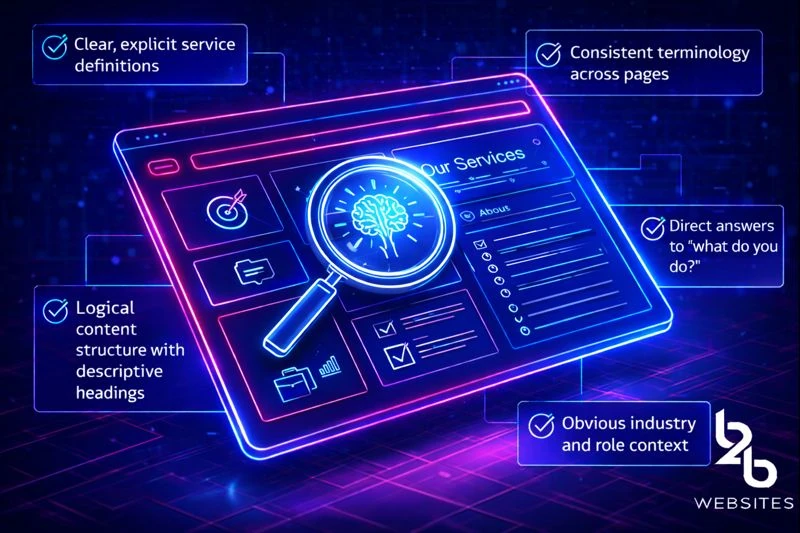
What does AI look for first when assessing a business website?
- Clear, explicit service definitions
- Logical content structure with descriptive headings
- Consistent terminology across pages
- Obvious industry and role context
- Direct answers to “what do you do?”
People also ask
Why does AI struggle with vague or generic website language?
AI struggles with vague language because it requires explicit meaning, not implied intent. Terms like “solutions” or “innovative services” do not clearly define what a business does, who it serves, or how it operates. Without concrete definitions, AI cannot reliably classify or recommend the business.
Can a visually strong website still fail AI understanding?
Yes. Visual design does not influence AI comprehension. AI evaluates structured text, headings, and semantic clarity, not aesthetics. A website can look polished to humans but still fail if services are unclear, content is unstructured, or language relies on branding instead of explanation.
The AI-readiness ladder progresses in four stages, each building on the one before it.
Level 1 AI-Readable: Can AI Clearly Understand What a Website Does?
AI can clearly understand what a website does when the site states its services, purpose, and role in plain, explicit language. If those details are implied, vague, or buried in branding copy, AI cannot reliably interpret the business.
Level 1, AI-Readable, is the foundation of AI-readiness. At this level, AI can accurately understand what a business does without guessing. Services are explicit, not implied. The industry and role are unmistakable. Content is structured so meaning is easy to extract rather than buried inside vague copy or long paragraphs.
Most websites fail here because they prioritise marketing language over functional explanation. Humans can infer meaning from tone and context; AI cannot. Phrases like “end-to-end support” or “tailored solutions” sound sophisticated but provide no operational clarity. If AI cannot name your services in plain terms, it cannot categorise you correctly, and you are excluded from relevant answers before trust or authority even come into play.
Level 1 does not require advanced technology or large volumes of content. It requires disciplined clarity. Clear service pages, consistent terminology, and descriptive headings are usually enough. Without this level, higher optimisation efforts will fail because AI cannot build on what it does not understand.
If you want to assess whether your own site meets this standard, you can explore our in-depth breakdown on what makes a business website truly AI-readable, where we examine the structural and language decisions that most often block AI understanding.
Why do so many websites fail at basic AI-readability?
Most websites fail at basic AI-readability because they prioritise brand language over explicit explanation. What feels clear to business owners or designers relies on shared context and human inference, which AI does not have. Without direct service definitions, consistent terminology, and structured headings, AI cannot reliably interpret what the business actually does.
What are the most common causes of poor AI-readability?
- Abstract marketing language
- Services explained indirectly
- Content blocks without clear headings
- Inconsistent naming across pages
- Assuming context instead of stating it
People also ask
How detailed do service descriptions need to be for AI?
Service descriptions need to be explicit enough that AI can identify the service, its purpose, and its audience without inference. Overly long explanations are unnecessary, but vague summaries prevent accurate classification.
Does simplifying language reduce brand sophistication?
No. Clear language improves AI understanding without diminishing brand value. Sophistication comes from precision, not complexity.
Level 2 AI-Trusted: Does AI See a Business as Credible and Legitimate?
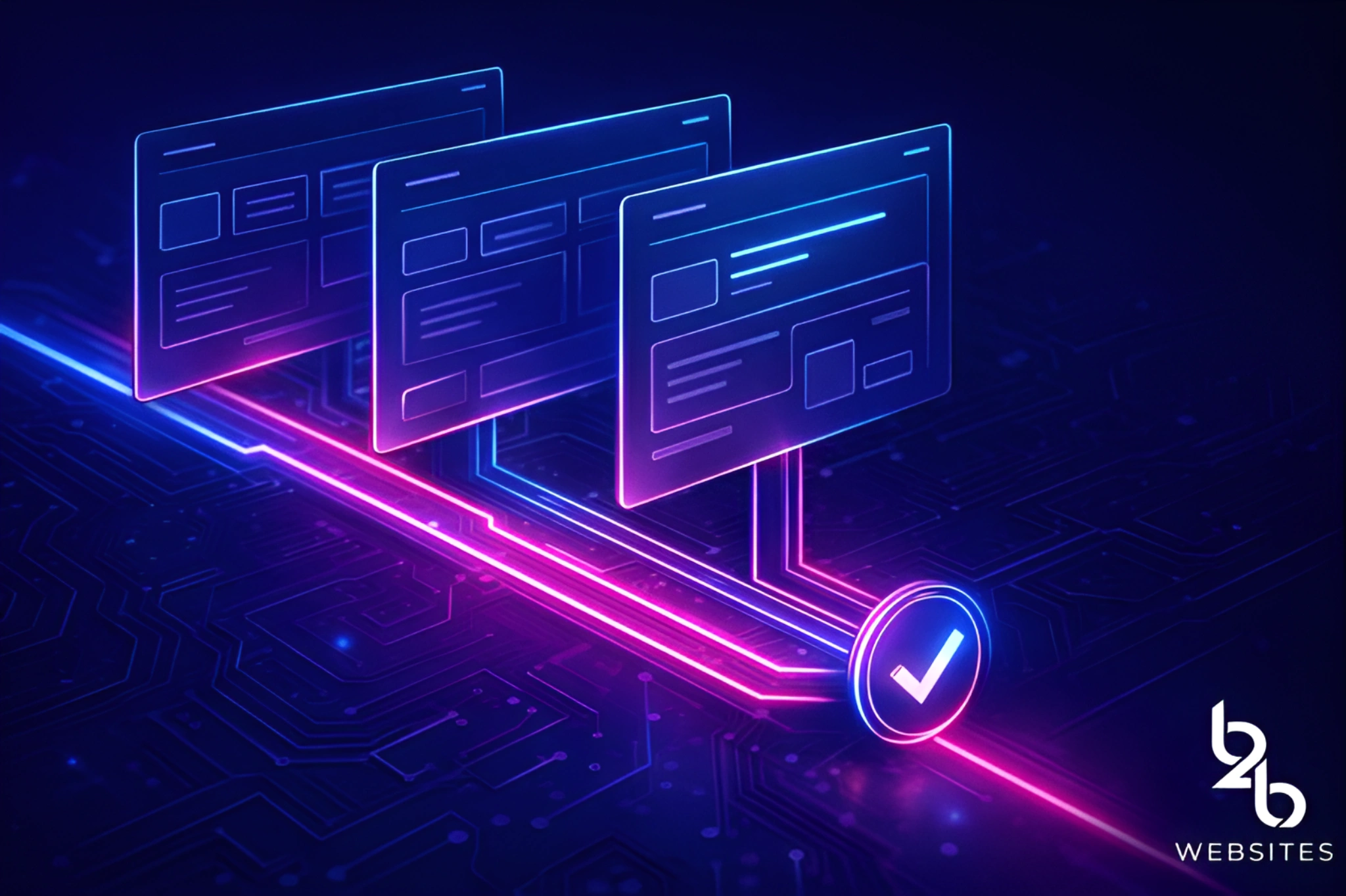
AI sees a business as credible when its claims are supported by clear, consistent, and verifiable proof. Once AI understands what a website does, it evaluates whether the business appears legitimate, experienced, and reliable rather than relying on unsubstantiated assertions.
Level 2, AI-Trusted, focuses on legitimacy, consistency, and verification. At this level, AI looks for evidence that supports what the website claims, including visible experience, stable messaging, and signals that can be confirmed across sources. Statements without proof are discounted.
Trust signals include testimonials, case studies, credentials, years of experience, and consistency across platforms. AI cross-references what your website says with what it can infer from elsewhere. If claims conflict or cannot be validated, trust decreases. This is why long-standing businesses only benefit from experience when it is clearly documented.
Consistency is critical at Level 2. Messaging, services, and positioning should align across your website and digital footprint. AI penalises inconsistency because it increases uncertainty. When trust is established, your business moves from noise to a legitimate option.
What signals does AI rely on most to assess trust?
AI assesses trust by weighing signals that are specific, repeatable, and verifiable across multiple sources. It looks for evidence that claims are supported by proof, that messaging remains consistent over time, and that credibility signals can be independently confirmed rather than inferred or assumed.
Which trust indicators matter most for AI systems?
- Verifiable testimonials and case studies
- Clear business history and experience
- Consistent service descriptions
- Recognisable credentials or partnerships
- Stable branding over time
People also ask
Do reviews matter more than case studies for AI trust?
No. Reviews and case studies serve different trust functions. Reviews signal external validation, while case studies demonstrate capability and outcomes. AI weighs both as credibility signals when they are specific, consistent, and verifiable.
Can small businesses compete with large brands at this level?
Yes. AI prioritises clarity and proof, not size. A small business with visible experience and documented outcomes can outperform a larger brand that relies on reputation alone.
Level 3 AI-Recommended: How Does AI Decide Which Businesses to Recommend?
AI decides which businesses to recommend by matching clear differentiation to specific user intent. When a website explains who it is best for, what problems it solves, and how it differs from alternatives, AI can confidently suggest it in the right context.
Level 3, AI-Recommended, is where AI begins actively suggesting your business. At this level, AI understands not only what the business offers, but when and why it is the right choice. This requires alignment with buyer intent and clear differentiation.
AI needs to know who you are best for. General claims like “we work with everyone” provide no recommendation logic. Level 3 websites define their ideal clients, use cases, and strengths relative to alternatives. Differentiation here is practical, not promotional. It explains fit, trade-offs, and context.
This is where visibility shifts from defensive to growth-oriented. AI recommendations become specific rather than generic, and traffic quality improves because poor-fit audiences are filtered out upstream.
How does differentiation help AI decide when to recommend you?
AI uses differentiation to decide who to recommend. It compares businesses to see which one best fits a specific need. If your website does not clearly explain who you are for or why you are different, AI cannot justify choosing you and will recommend a clearer option instead.
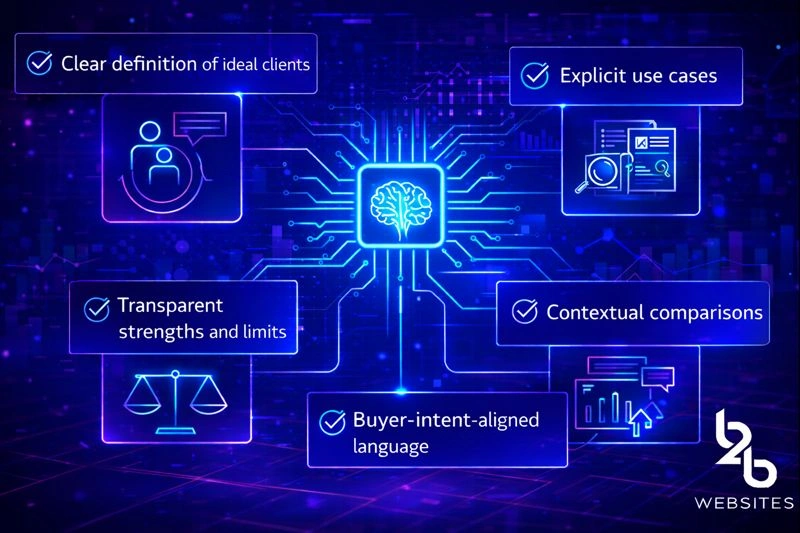
What kinds of differentiation help AI recommendations most?
- Clear definition of ideal clients
- Explicit use cases
- Transparent strengths and limits
- Contextual comparisons
- Buyer-intent-aligned language
People also ask
Is niche positioning required for AI recommendations?
No, but it improves accuracy. AI recommends businesses more confidently when it understands who they are best suited for and in what context.
Can generalist businesses still reach Level 3?
Yes. Generalists reach Level 3 by clearly defining scenarios, industries, or problems they handle well, rather than claiming universal capability.
Level 4 AI-Dominant: When Does AI Treat a Business as an Authority?
AI treats a business as an authority when it consistently reinforces a clear perspective that others reference rather than repeat. At this level, AI does not simply recommend the business but uses it as a point of comparison or explanation.
Level 4, AI-Dominant, is rare. At this level, AI treats a business as an authority rather than an option. Its perspective influences how topics are explained. Competitors are compared to it, not alongside it.
AI-dominant websites publish proprietary insights, frameworks, or data. They define categories rather than react to them. Authority compounds because AI repeatedly references the same source over time. This level requires long-term consistency and originality, not volume.
Why is Level 4 so difficult to achieve?
Level 4 is difficult to achieve because authority must be demonstrated consistently over time, not claimed once. AI looks for repeated, original signals such as proprietary insight, stable positioning, and ongoing validation. When those signals are inconsistent or short-lived, authority does not compound.
What separates AI-dominant businesses from others?
- Proprietary frameworks
- Original insights
- Consistent category focus
- Long-term optimisation
- Recognition as a reference
People also ask
How long does it take to reach AI-dominance?
Typically years. AI looks for sustained authority signals over time, not short-term optimisation.
Is Level 4 realistic for small or mid-sized businesses?
Yes, within narrow categories. Authority comes from ownership of perspective, not company size.
From Brochure to Signal: Why This Matters Now
AI is not “coming”. It is already shaping how businesses are discovered, evaluated, and recommended. When someone asks a question, AI systems decide which businesses are understood, which are credible, and which are worth mentioning. If your website is not clearly interpreted, AI does not wait. It moves on.
If your website:
- Isn’t clearly understood by AI
- Doesn’t demonstrate authority or credibility
- Doesn’t explain why you over alternatives
AI will still make a choice, just not in your favour.
Most often, it defaults to:
- Directories
- Aggregators
- Generic brands with clearer structure and signals
Not because they are better, but because they are easier to interpret. For a deeper look at how this shift is already affecting Australian businesses, we have explored how Google’s AI Overviews are changing website discovery and decision-making, and what it means for websites that want to remain visible as AI-driven search evolves.
The Good News
AI-readiness is not about rebuilding everything overnight. It is about knowing where your website currently sits on the AI-readiness ladder and fixing the right problems first. Foundational clarity unlocks trust. Trust enables recommendation. Recommendation creates growth. Each step builds on the last.
This approach protects visibility today while positioning your business for long-term advantage as AI-driven discovery accelerates.
The Real Question AI Is Asking About Your Website
Your website is no longer just a digital brochure. It is a data source for AI, a credibility engine, a recommendation signal, and a competitive differentiator. The question is no longer whether your website looks good. It is whether AI can understand, trust, and recommend your business. If it cannot, the gap between you and clearer competitors will only widen.
This article introduces the AI-readiness ladder, but each level deserves deeper attention. In our media hub, we will be delving deeper into each stage, from making a website clearly readable by AI to building authority that AI recognises and references over time. If you want to follow how this framework evolves into practical guidance, you can explore our media hub as we continue to expand on each level.
If this has prompted you to reflect on how your own website is positioned today, our website provides broader context on how we think about website strategy, structure, and long-term performance. It is a starting point for understanding how these ideas translate into real-world decisions, without assuming any one-size-fits-all approach.
FAQs
What is AI-readiness?
AI-readiness is how effectively AI systems can understand, trust, and recommend your business.
Is AI-readiness the same as SEO?
No. SEO focuses on rankings, while AI-readiness focuses on comprehension and recommendation.
Do I need AI tools to be AI-ready?
No. Structure, clarity, and credibility matter more than tools.
Is AI-readiness a one-time task?
No. It evolves as AI systems and user behaviour change.
Can AI-readiness improve lead quality?
Yes. Better AI matching filters out poor-fit audiences.
Where should I start?
Start with clarity. If AI cannot clearly understand what you do, nothing else works.










%2520-%2520Main%2520Image.jpeg)
Versatility Across All Platforms


How can i help you today?


