

What Makes the AI Revolution Different?
What Is the AI Revolution?
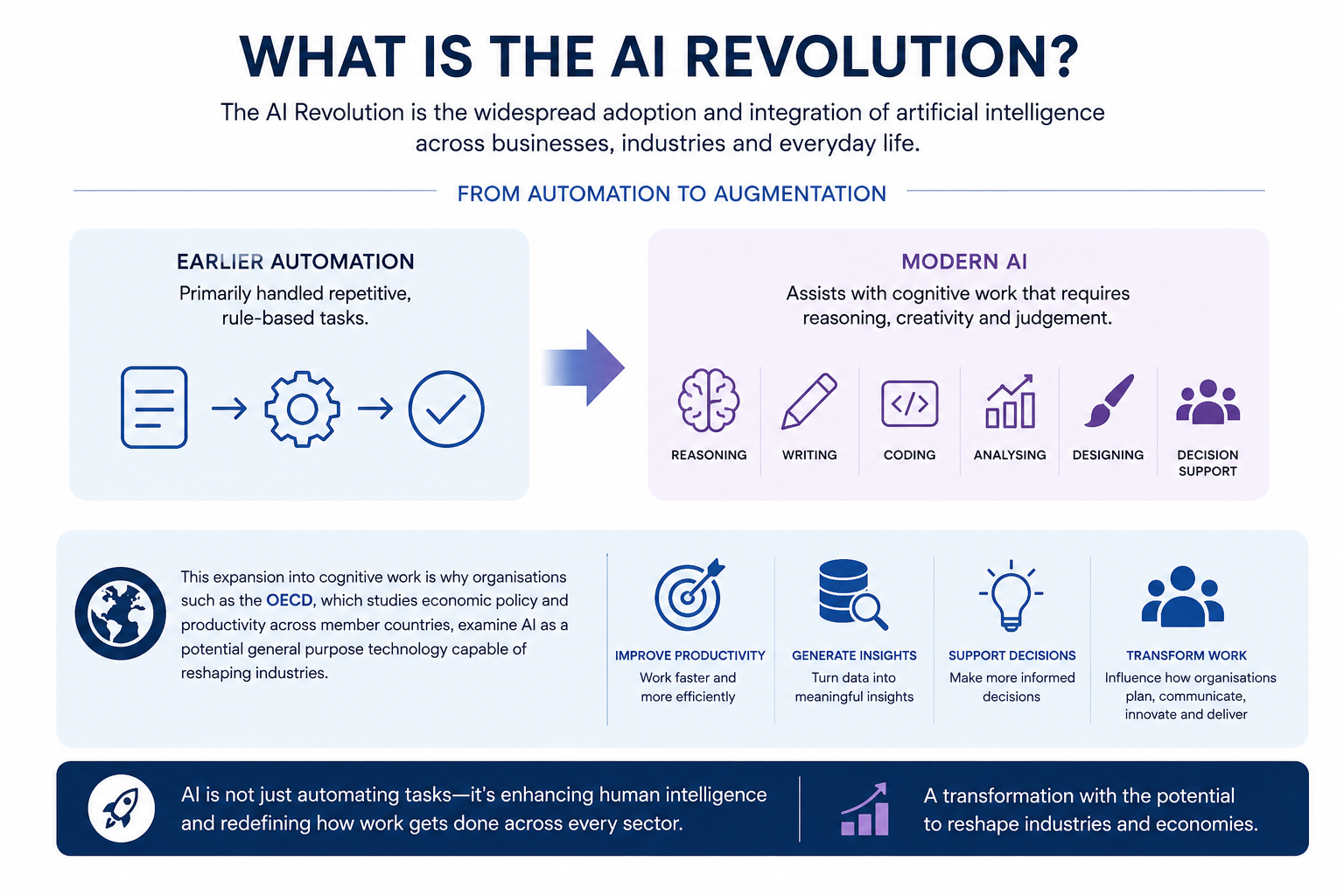
The AI Revolution describes the widespread adoption and integration of artificial intelligence across businesses, industries and everyday life. Unlike earlier automation technologies that primarily handled repetitive tasks, modern AI can assist with reasoning, writing, coding, analysing, designing and decision support. This expansion into cognitive work is why organisations such as the Organisation for Economic Co-operation and Development (OECD), which studies economic policy and productivity across member countries, examine AI as a potential general purpose technology capable of reshaping industries.
The term "AI Revolution" describes the rapid integration of artificial intelligence into everyday business operations, professional services and consumer technology. While artificial intelligence has existed for decades, recent advances in generative AI, machine learning and large language models have accelerated its adoption across virtually every sector. Businesses are increasingly using AI to improve productivity, automate repetitive work, generate insights from data and support more informed decision making. Rather than replacing a single task, AI is beginning to influence how organisations plan, communicate, innovate and deliver services. This is why organisations such as the OECD and the International Monetary Fund (IMF), which analyses global economic trends and growth, study AI's broader impact on productivity, labour markets and economic transformation rather than viewing it as simply another software innovation.
Unlike previous waves of technological change, the AI Revolution is expanding beyond automation into work that has traditionally depended on human judgement, creativity and expertise. That shift raises an important question: what makes this technological revolution fundamentally different from every major industrial transformation that came before it?
One of the most visible examples of this change is how customers discover information online. AI is beginning to reshape the traditional search journey, moving businesses from competing only for clicks and rankings towards being understood and recommended by AI systems. We explore this shift in more detail in our article on how AI is changing website discovery.
Why Is the AI Revolution Different From Past Industrial Revolutions?
The AI Revolution stands apart from previous industrial revolutions because it is one of the first major technological shift to significantly amplify human thinking and decision making rather than primarily expanding physical capability or mechanical efficiency. Instead of simply helping people produce, transport or communicate more, AI enhances reasoning, analysis, creativity, decision support and problem solving across almost every industry.
Every major industrial revolution removed a different economic bottleneck by expanding a specific human capability. Steam power multiplied muscle. Electricity multiplied production. Computers multiplied calculation. The internet multiplied communication. Each breakthrough enabled businesses to work faster, produce more or exchange information more efficiently. Yet each of these revolutions primarily extended physical capability, production capacity or information access rather than the ability to interpret, create and make decisions from information.
This shift from improving physical output to enhancing knowledge based work is why AI is being studied differently from previous technological revolutions. While previous revolutions changed what people could build, move or communicate, AI has the potential to change how information is interpreted, ideas are generated, and decisions are supported. Its ability to influence many industries has led researchers to study AI alongside earlier general-purpose technologies such as electricity and computing, recognising its potential to reshape how organisations operate over the coming decades. Understanding this distinction provides important context for why AI is expected to have such far-reaching business and economic consequences.
How Does AI Expand Human Cognitive Capability?
AI changes knowledge work by assisting with reasoning, writing, analysing, coding, designing and decision support rather than simply automating repetitive physical tasks. This ability to enhance knowledge work distinguishes AI from previous industrial technologies that primarily improved physical productivity or mechanical efficiency.
Earlier technological revolutions primarily improved physical productivity by reducing the time and effort required to manufacture goods, transport materials or process calculations. AI shifts that focus to knowledge work, supporting tasks that have traditionally relied on human expertise, judgement and creativity. Rather than replacing professional thinking, AI increasingly acts as an intelligent assistant that helps people work faster, evaluate more information and make better informed decisions.
Which Types of Cognitive Work Can AI Support?
- Research and knowledge work: Speeds up information gathering, document review and content creation, allowing professionals to spend more time on strategic work.
- Decision support: Analyses large volumes of information to highlight trends, risks and opportunities that support faster, more informed business decisions.
- Writing and drafting: Produces reports, proposals, emails and marketing content that staff can review, refine and personalise.
- Analysis: Identifies patterns and insights across business data that would otherwise require hours of manual investigation.
- Pattern recognition: Detects relationships, anomalies and emerging trends that support forecasting, planning and operational improvement.
These capabilities do not eliminate the need for human expertise. Instead, they augment it. Professionals remain responsible for applying judgement, context and ethical oversight, while AI accelerates many of the cognitive tasks that previously consumed significant time and effort. This shift from physical productivity toward knowledge based productivity is one of the defining characteristics of the AI Revolution.
Why Is the AI Revolution Compared to the Industrial Revolution?
The AI Revolution is often compared to the Industrial Revolution because both fundamentally changed how economies create value across almost every industry. The comparison is based on their economy wide impact rather than any technical similarity between steam engines and artificial intelligence. Unlike many previous technological advances that initially improved specific processes or industries, AI has the potential to influence productivity across a wide range of sectors.
That broad economic reach is why economists are studying whether AI may follow the adoption patterns of earlier general-purpose technologies such as electricity, where the greatest benefits emerged after organisations redesigned how they operated. It is also why organisations such as PwC, the OECD and the International Monetary Fund increasingly assess AI in terms of national productivity, economic growth and long-term competitiveness rather than software adoption alone.
What Economic Evidence Supports AI's Transformational Potential?
Economic forecasts suggest AI's impact could extend well beyond individual businesses, influencing productivity, investment and economic growth across multiple industries. This economy-wide potential is one of the main reasons AI is frequently compared with foundational technologies such as electricity. PwC, the global professional services firm, estimates AI could add USD 15.7 trillion to global GDP by 2030, highlighting why economists and industry researchers increasingly analyse AI as an economy-wide transformation rather than another software innovation.
AI's Impact on Reasoning, Writing and Analysis Sets It Apart
What sets AI apart within that comparison is where the productivity gain originates. According to PwC's analysis, roughly USD 6.6 trillion of that projected gain comes from productivity improvements and USD 9.1 trillion from AI-enabled products and consumer demand, with China projected to see a 26 per cent GDP boost and North America around 14.5 per cent by 2030. Those figures sit squarely in white collar, cognitive and service industries rather than heavy manufacturing, which is a marked departure from how earlier revolutions distributed their economic impact.
People Also Ask
Do all economists agree on the scale of AI's economic impact? No, forecasts vary considerably between institutions, and most economists caution that adoption speed, regulation and workforce readiness will determine whether projected gains are fully realised.
Which industries are expected to see the earliest productivity gains from AI? Professional services, financial services and retail are commonly cited as early movers, largely because they involve high volumes of document processing, analysis and customer interaction that AI tools can support directly.
Example: a financial services firm reducing document processing cycles by adopting AI-assisted review reflects exactly the kind of productivity gain economists are pointing to when making the Industrial Revolution comparison.
How Did Previous Technology Revolutions Amplify Human Physical Capability?
Earlier technology revolutions extended what human bodies and machines could physically do, not what people could think through. Steam power multiplied muscle, electricity multiplied production, computers multiplied calculation, and the internet multiplied communication, each one scaling a physical or mechanical bottleneck rather than a cognitive one.
Why Did Earlier Revolutions Focus on Physical Output Rather Than Thinking?
Earlier revolutions targeted physical bottlenecks because that is where economic constraints sat at the time. Factories were limited by human and animal strength, so steam engines solved that. Manufacturing was limited by power distribution, so electricity solved that. Businesses were limited by manual calculation and record keeping, so computers solved that. Advanced reasoning, judgement and analysis have historically relied heavily on human expertise, which is one of the reasons the AI Revolution represents a significant shift in how technology interacts with knowledge work.
Steam, Electricity, Computing and the Internet Show a Clear Pattern
Reviewing these four revolutions side by side shows a consistent pattern: each one removed a physical constraint on production or distribution, but none of them touched reasoning, writing or judgement. This consistency across roughly two centuries of industrial history helps explain why economists studying technological change examine AI differently from previous waves of innovation.
What Patterns Did Every Major Industrial Revolution Follow?
- Each solved a widespread productivity constraint rather than a niche problem.
- Each became more valuable as adoption spread across industries.
- Each required businesses to rethink established workflows instead of making minor improvements.
- Each created opportunities for entirely new products, services and occupations.
- Each eventually became essential infrastructure rather than a competitive advantage.
People Also Ask
Was the internet considered a foundational technology in its own right? Yes. Researchers studying general-purpose technologies often classify the internet alongside technologies such as electricity and computing because it reshaped how businesses communicate, operate and deliver services across industries.
Did earlier revolutions also change the types of jobs available? Yes, each revolution eliminated some manual roles while creating new categories of skilled work, a pattern studied in AI workforce research, including analysis from organisations such as the OECD, although the specific roles affected will differ.
Example: factory floor supervisors during the electrification era shifted from managing manual labour teams to overseeing powered machinery, a role change comparable to how many knowledge workers are now shifting from manual drafting to AI assisted review.
Why Is AI Considered a Foundational Technology?
AI is increasingly being viewed as a foundational technology because it has the potential to become embedded across many industries, changing how organisations operate rather than solving a single problem. Like electricity before it, AI is increasingly viewed as business infrastructure that supports productivity, innovation and decision making across the economy.
What Does It Mean for a Technology to Be Foundational?
A foundational technology becomes essential infrastructure that supports a wide range of industries rather than remaining confined to a single application. Electricity is one of the best historical examples. Manufacturers, retailers, banks and healthcare providers all eventually relied on it, not because they operated in the same industry, but because electricity became essential infrastructure. Once electricity became widely available, the question was no longer whether businesses should adopt it, but how they could use it most effectively. Researchers studying general-purpose technologies have observed that technologies such as electricity created their greatest value when businesses redesigned processes around them rather than simply adopted the technology.
What Are the Signs a Technology Has Become Foundational?
Foundational technologies tend to share several characteristics regardless of the industry they affect. They spread widely, become embedded in everyday operations and reshape how organisations work rather than simply making existing processes faster.
- It solves problems across many unrelated industries rather than one niche market.
- Businesses begin treating it as essential infrastructure rather than an optional investment.
- Productivity gains compound as adoption spreads across more industries.
- New business models, professions and services emerge around it.
- Organisations redesign workflows instead of simply layering AI onto existing processes.
Why Is AI Compared to Electricity?
AI is compared to electricity because both represent foundational shifts: the real economic value comes from redesigning how work gets done, not just adding new technology to old processes. Electricity transformed industry through new factory layouts and operating models. Stanford economist Erik Brynjolfsson, known for his research on technology and productivity, argues that the largest productivity gains from AI will come from redesigning business processes rather than simply adding AI tools to existing workflows.
Early Australian adoption data suggests this transition has already begun. According to the Australian Bureau of Statistics, AI adoption among large Australian businesses increased from 9% in 2021 to 2022 to 35% in 2024 to 2025, while adoption among medium sized businesses rose from 3% to 22% over the same period. This pattern mirrors the early stages of other foundational technologies, where adoption accelerates as practical business value becomes clearer. While adoption is still evolving, the trend suggests AI is moving beyond early experimentation and towards becoming a standard part of business operations.
People Also Ask
Is electricity still a useful comparison given how different AI is technically? Yes, economists use electricity as a structural comparison rather than a technical one, focusing on adoption patterns and economic reach rather than how either technology actually works.
Why are businesses redesigning workflows instead of simply adding AI tools? Because the largest productivity gains come from redesigning business processes around AI rather than using it to automate isolated tasks. Organisations that rethink workflows typically achieve greater long-term efficiency than those that simply add another software tool.
How Is the AI Revolution Playing Out in Australian Businesses Right Now?
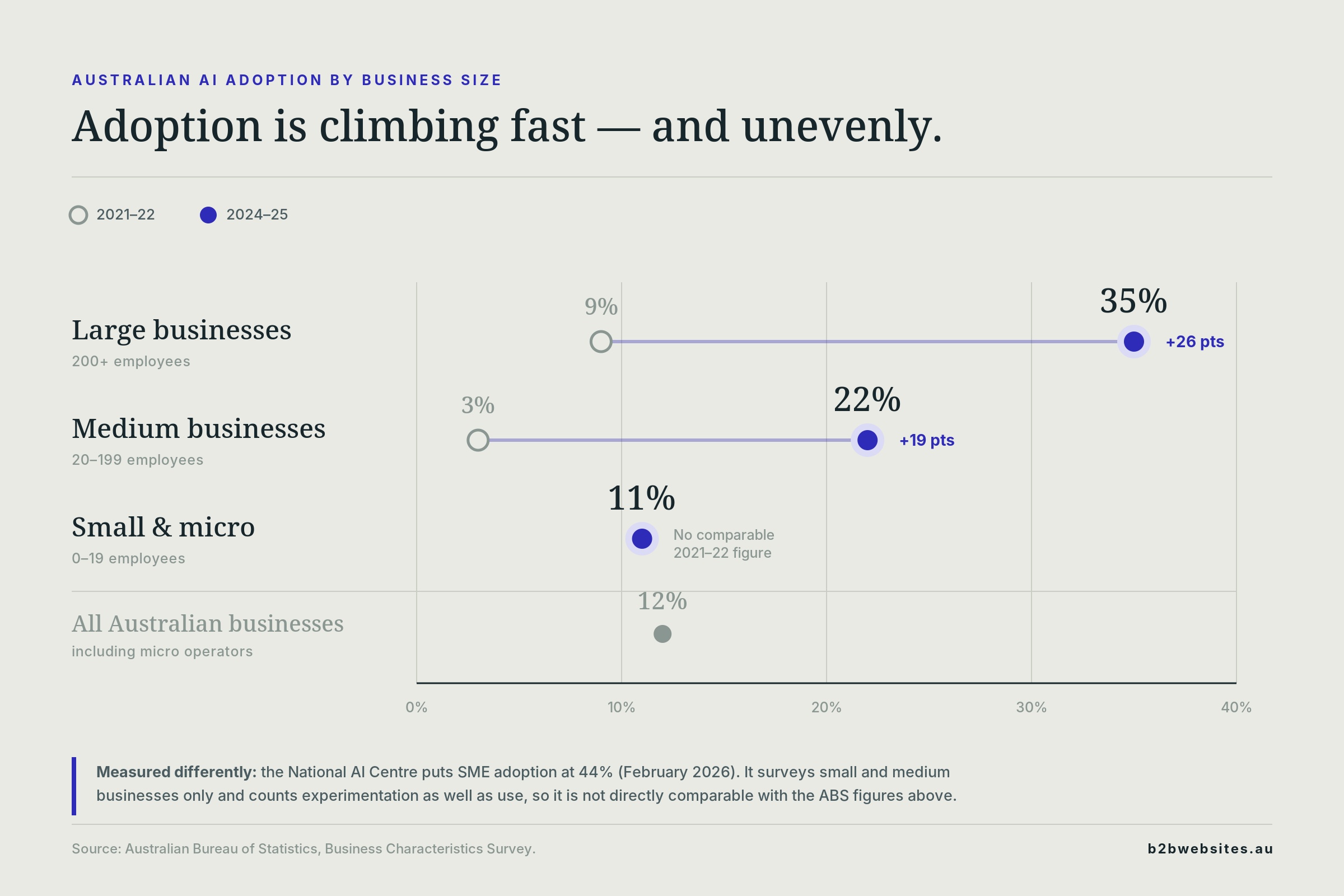
Australian AI adoption is increasing steadily but remains uneven across business size and industry, with large enterprises moving ahead of smaller businesses. National data shows adoption climbing steadily, alongside a substantial projected economic opportunity that most Australian businesses have not yet captured.
How Many Australian Businesses Have Adopted AI So Far?
According to the Australian Bureau of Statistics Business Characteristics Survey, around 12% of Australian businesses reported using AI in the workplace during 2024 to 2025, with adoption highest in information, media and telecommunications at 38%, and professional, scientific and technical services alongside financial and insurance services both at 24%. The difference reflects how adoption is measured. The ABS surveys the broader Australian business population, including micro businesses, while the National AI Centre's Adoption Tracker focuses specifically on SMEs and measures AI experimentation and use across that group.
The Economic Opportunity for Australian Industries Is Substantial
The scale of the opportunity is considerable even where adoption still lags. The Tech Council of Australia, working with Microsoft, estimated generative AI alone could contribute between AUD 45 billion and AUD 115 billion annually to the Australian economy by 2030, with around 70% of that value coming from productivity gains rather than new products or services. Around 65% of Australian businesses that have not adopted AI cited distrust in AI decision-making or a preference to maintain human control, according to the National AI Centre, suggesting that many organisations are being held back less by access to AI tools and more by questions around trust, governance and how AI should be implemented responsibly.
Australian Business AI Adoption Snapshot
Figure
Large businesses using AI, 2024-25 (up from 9% in 2021-22)
35%
Medium businesses using AI, 2024-25 (up from 3% in 2021-22)
22%
Small and micro businesses using AI, 2024-25
11%
SME AI adoption, February 2026 (National AI Centre)
44%
Projected annual economic contribution by 2030 (Tech Council/Microsoft)
AUD 45bn to AUD 115bn
People Also Ask
Which Australian industries have the highest AI adoption rates today? Information, media and telecommunications lead at 38%, followed by professional, scientific and technical services and financial and insurance services, both around 24%, according to the Australian Bureau of Statistics.
Why do many small Australian businesses hesitate to adopt AI? Cost, limited technical resourcing and a preference to retain human oversight over decisions are commonly cited reasons, alongside genuine uncertainty about which tools suit a smaller operation.
A practical example is a mid-sized professional services firm beginning with a single AI-assisted workflow, such as document review, before expanding further. This staged approach reflects how many organisations are approaching AI adoption: starting with controlled use cases before wider implementation.

What Comes Next as AI Becomes Foundational Infrastructure?
The AI Revolution is different because it represents one of the first major technology shifts focused on amplifying human thinking and knowledge work rather than primarily improving physical output, and the economic data across both global and Australian markets increasingly treats it as foundational rather than optional. Businesses that once asked whether AI was relevant to their industry are increasingly asking how quickly they can integrate it without disrupting the parts of their operations that already work well.
What separates the businesses that benefit from this shift from those left behind by it: is it the tools they choose, or how deliberately they redesign their workflows around them?
The next few years may not be defined by which businesses simply use AI, but by which ones successfully adapt their workflows, processes and strategies around it.
Navigating that shift without a clear strategy is where most Australian businesses lose momentum, caught between chasing every new AI tool and doing nothing at all. B2B Websites works with Australian businesses to build websites, content and digital strategies that are ready for an AI driven search and business landscape, turning foundational technology shifts into practical, measurable advantage rather than another item on a to-do list.
For more insights like this, B2B Websites maintains a growing media hub of in-depth articles designed to help forward-thinking Australian businesses stay ahead of exactly this kind of change, such as how AI is already changing how customers discover businesses, particularly in local search.
Frequently Asked Questions
What industries will the AI Revolution affect the most? Professional services, financial services, retail, healthcare and manufacturing are expected to see the earliest and largest impact, based on current Australian and global economic modelling.
How much does it cost an Australian business to start adopting AI? Costs vary widely depending on scope, ranging from low-cost off-the-shelf AI tools to custom strategic implementation, so most businesses benefit from starting with a single high value workflow rather than a full scale rollout.
Is AI expected to replace jobs or change them? Most economic modelling points to task transformation rather than wholesale job replacement, with routine tasks automated while demand grows for skills in oversight, strategy and AI-assisted analysis.
How is the AI Revolution different from the dot-com boom? The dot-com boom primarily expanded communication and access to information, while the AI Revolution is amplifying reasoning and decision making, a structurally different type of economic impact.
What is the first step for a business wanting to prepare for AI as a foundational technology? Auditing existing workflows to identify where reasoning, writing or analysis creates the biggest bottleneck is typically the most effective starting point, rather than adopting AI tools without a clear use case.
Can a small or medium Australian business get strategic help implementing AI-ready digital infrastructure? Yes, agencies such as B2B Websites offer strategic guidance to help Australian businesses build websites and content systems that are structured for both AI-driven search and internal AI adoption.







%2520-%2520Main%2520Image.jpeg)
Versatility Across All Platforms


How can i help you today?


