

Why Is the Tradie Down the Road Getting All the Work?
Why Is the Tradie Down the Road Getting All the Work?
What Every Trade Business Needs to Know About local search
For years, local SEO followed a familiar formula. Trade businesses collected reviews, aimed for a spot in the Google Maps pack, and optimised a website with the right keywords. That formula still matters, but it is no longer enough on its own. Artificial intelligence has entered local search, and it is changing how Australian tradies get found by the people who need them.
AI tools such as ChatGPT, Gemini, and Google's AI features, including AI Mode and AI Overviews, are no longer novelties. Roy Morgan, a leading market research firm, found that 13.6 million Australians aged 14 and over now use an AI tool over an average period of four weeks, representing 58% of that population. Telsyte's 2026 figures put usage even higher, with ChatGPT alone reaching 13.8 million Australian users. This matters for trade businesses because a growing share of local searches, such as "best plumber near me" or "reliable electrician for commercial work", are being typed straight into an AI assistant instead of Google. Rather than scrolling through a page of search results, the person asking may instead receive one or two recommendations. Being one of those names now depends on far more than a decent Google ranking. It depends on whether AI systems can understand a business, trust it, and confidently recommend it. That means local SEO is no longer just about ranking highly in Google. It's about becoming a business AI systems are confident enough to recommend by name.
How AI Is Changing the Way Australians Search for Tradies
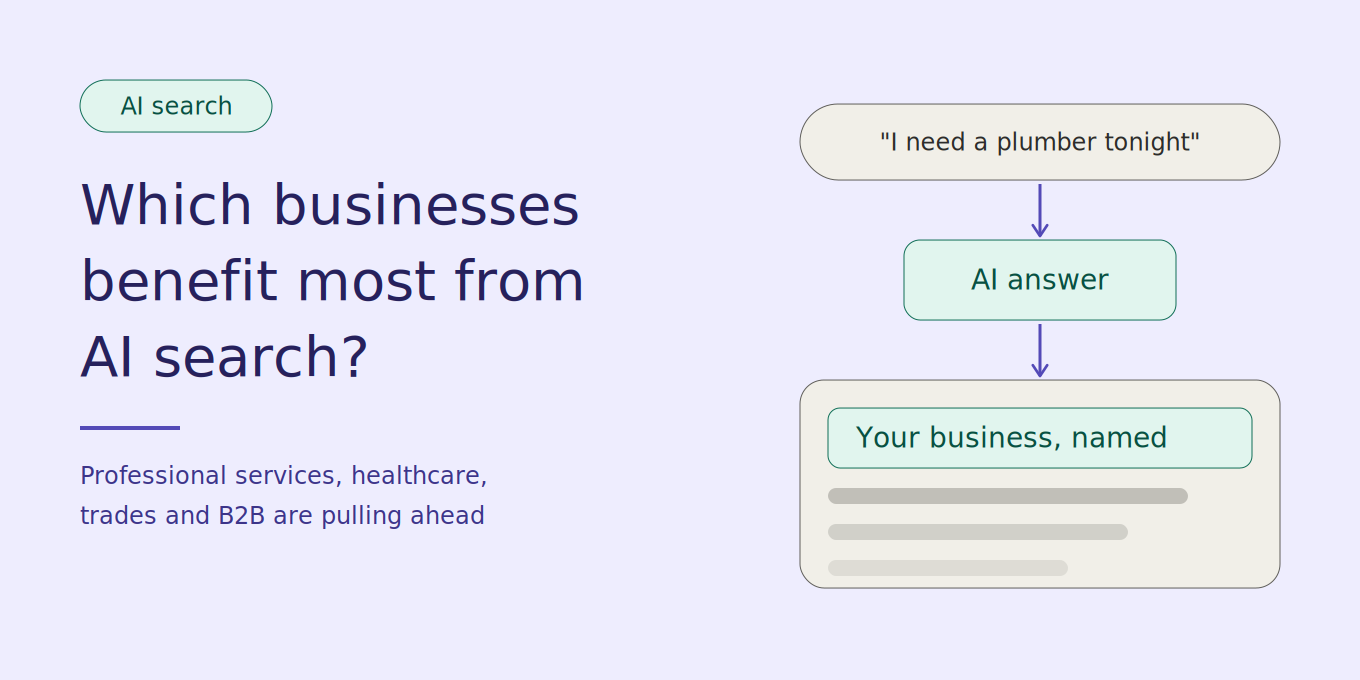
Australians increasingly ask AI tools the same questions they used to type into Google, and the shape of the answer they get back is fundamentally different. Instead of a results page with ten options to compare, AI tools tend to name a small handful of businesses, sometimes only one, based on how well those businesses present and verify themselves online. That shift changes what "ranking" actually means for a trade business.
How AI Chooses Which Businesses to Recommend
When a person asks an AI assistant a question like "who installs air conditioning in North Lakes", the tool does not return a list of links. It synthesises an answer from multiple sources, including websites, directories, review platforms and Google Business Profiles, then names the businesses it considers the strongest match. If the information about a business is thin, inconsistent or hard to verify, it is simply left out of that answer.
AI Narrows the Field Instead of Listing Everyone
A recent study by Snowball Productions, an Australian digital marketing agency, tested fifty everyday consumer questions across ChatGPT, Perplexity, Gemini and Google AI Mode. The research found that no local business was named at all in 46% of the answers, meaning nearly half the time, AI systems did not identify a local business with enough confidence to recommend one. For trade businesses, this is the real risk. It is no longer just about losing a ranking position. It is about being left out of the answer entirely.
This shift is part of a much broader change in how Australians discover businesses online. We explore this in more detail in The Great Website Bypass, where we explain why AI increasingly answers questions directly instead of sending users to websites first.
Rather than typing a few keywords, people increasingly describe their situation or ask AI a complete question. Common examples include:
- Best plumber near me
- Who installs air conditioning in North Lakes?
- Reliable electrician for commercial work
- Emergency roof repairs open now
- Licensed builder for a home extension
People Also Ask
Why do some searches still show a full list of businesses instead of just one or two? Simpler or less critical queries, such as general categories, often still trigger a traditional results page, while specific or urgent queries are more likely to produce a narrow AI answer.
Which is better, local SEO or paid search? Paid search can deliver immediate visibility, while local SEO builds long-term credibility and organic traffic. Most trade businesses benefit from using both as part of their marketing strategy.
Does this trend apply equally across all trades? No. Emergency and trades where trust matters most, such as electricians and plumbers, tend to see AI narrow the field faster than less urgent categories like landscaping.
Example: A homeowner searching for an emergency electrician after hours is far more likely to receive one confident AI recommendation than a full list of nearby options.

Why Some Trade Businesses Get Recommended by AI
Businesses that are easy for AI to understand tend to share a consistent set of traits, including strong reviews, clear service pages, dedicated suburb pages, a Google Business Profile that is kept up to date and genuinely helpful content. These signals give AI systems confidence, and confidence is what drives a recommendation.
What Makes a Business Easy for AI to Recommend?
AI systems favour businesses that remove ambiguity. A business with a generic homepage and no detail on specific services or suburbs gives an AI tool very little to work with, while a business with clear, specific information is far easier to match to a specific query. The clearer the signals, the more likely a business is to be named.
To see why these signals matter, it helps to understand how AI interprets information in the first place. Learn why better questions lead to better AI answers and what that means for the content your business creates.
AI is more likely to recommend businesses that consistently demonstrate the following signals:
- Consistent, recent reviews that show the business is active and trustworthy.
- Dedicated suburb pages that help match the business to very specific local searches.
- Clear service pages explaining exactly what services are offered.
- A complete and regularly updated Google Business Profile with accurate business information.
- Helpful content that answers common customer questions and demonstrates expertise.
Do Google Reviews Still Matter in an AI Search World?
Reviews remain one of the strongest trust signals for both customers and AI systems. Research from Starworks, a digital marketing consultancy, found that 94% of Australian consumers read reviews before buying, and 78% trust online reviews as much as a personal recommendation. Google Reviews remains the dominant platform at 89% usage, while Hipages holds a strong position specifically among tradies and service providers. AI tools draw on this same review data to judge whether a business is credible enough to name.
Signals That Make a Trade Business Easier for AI to Trust
- A steady stream of recent reviews, not just a large historical total
- Dedicated pages for each suburb or service area covered
- Service pages that spell out exactly what is included
- A complete, regularly updated Google Business Profile
- Content that answers real questions customers actually ask
People Also Ask
Does having more reviews always beat having a higher star rating? Not necessarily. Research cited by Starworks suggests businesses with a 4 to 4.5 star rating can appear more credible than a suspiciously perfect 5 out of 5 rating, since consumers expect some natural variation.
Are backlinks important for local SEO? Yes, but they are only one part of local SEO. Accurate business information, quality reviews and helpful content often have a greater impact on local visibility for trade businesses.
Which review platform matters most for trades specifically? Google Reviews carries the broadest general weight, but Hipages is described as the dominant platform specifically for tradies and service providers in the Australian market.
Example: A plumbing business that responds thoughtfully to a handful of critical reviews often builds more trust than one with zero negative feedback at all.
Building Local Authority That AI Can Trust
AI systems place significant weight on consistency across a business's digital presence, meaning a business's name, address, services and contact details need to match across its website, Google Business Profile, review platforms, directories and social media.
Consistency helps establish trust. Before AI can evaluate that trust, however, it first needs to clearly understand what a business actually does. Our guide, Is Your Business Website AI-Readable?, explains how website structure, clear service definitions and straightforward language help AI interpret a business with confidence.
Why Does Consistent Information Matter So Much to AI?
AI systems compare information from multiple sources before naming a business in an answer, and mismatched details, such as an old phone number on one directory or a different suburb listed on social media, create doubt rather than confidence. A business with identical information everywhere is simply easier to verify, and easier to verify means easier to recommend.
Local Intent Is a Bigger Part of Search Than Many Realise
Local intent already accounts for a substantial share of everyday search behaviour in Australia, with industry research suggesting close to 46% of all Google searches carry some form of local intent. That scale is exactly why AI systems have been trained to weigh local signals so heavily, and why gaps or inconsistencies in a trade business's online presence carry a real cost.
Where Local Authority Signals Need to Line Up
- Website contact details and service area pages
- Google Business Profile listing and categories
- Review platforms, including Google and Hipages
- Local and industry directories
- Social media bios and pinned contact information
People Also Ask
What is the fastest way to check if a business's details are consistent online? Searching the business name alongside its suburb across Google, major directories and social platforms will usually surface any mismatched addresses, phone numbers or trading hours.
Do directory listings still matter if a business already ranks well on Google? Yes. Directories act as an additional trust signal that AI systems compare with other sources, so an absent or outdated directory listing can still undermine an otherwise strong Google presence.
Example: A business listed as "North Lakes Air Conditioning" on its website but "North Lakes Air Con Services" on a directory creates exactly the kind of inconsistency that makes AI hesitate to recommend it.
Why Website Structure and Schema Markup Matter to AI
Website structure and schema markup can significantly influence how easily AI systems understand and verify a business. While they are traditionally considered part of technical SEO, they have become an important supporting element of modern local SEO as AI systems rely on structured, machine readable information when deciding which local businesses to recommend. A site with a clear layout and well implemented schema provides structured information that helps AI systems interpret, verify, and confidently reference a business when generating answers.
Reviews, suburb pages and consistent listings help a business get discovered, but the underlying technical build of a website, including its layout, code structure and schema markup, allows AI systems to understand and verify that information in the first place. A well written service page still needs to be built in a way machines can interpret, or AI has less structured information it can confidently cite.
What Is Schema Markup and Why Does AI Rely On It?
Schema markup is a standardised layer of code added to a website that explicitly labels what each piece of content means, such as marking a phone number as a phone number or a suburb as a service area, rather than leaving AI to infer meaning from plain text alone. Without it, AI systems have to guess, which increases the risk of a page being misread or skipped altogether. Search Engine Land has reported that Google's search team continues to recommend structured data as a best practice for helping search systems understand website content. Microsoft has similarly explained that schema markup helps Bing and Copilot better interpret web pages.
Most Australian SME Websites Are Not Built for AI at All
Industry research suggests structured data remains underused across many small business websites, leaving businesses without the machine readable signals AI systems increasingly use to interpret and verify information. This gap exists despite schema being one of the more cost effective technical improvements available, with several SEO industry studies associating well implemented structured data with higher click through rates by improving how search results appear.
For trade businesses competing in AI search, this represents a genuine opportunity rather than just a risk, since so few competitors have addressed it properly. A website built with clean semantic structure, a logical sitemap and properly implemented schema, including structured business information that tells AI systems who the business is, where it operates and what services it provides, gives AI systems clearer, more reliable information to interpret and verify.
People Also Ask
Does every page on a website need schema markup? No. The priority is Organisation and LocalBusiness schema on core pages, since misapplied schema on unrelated pages has been linked to reduced performance in recent search updates.
Can a business add schema markup without rebuilding its entire website? Yes. Schema is typically added directly into a site's existing code, so a well structured site can usually have it implemented without a full rebuild.
Example: A trade business with LocalBusiness schema correctly matching its Google Business Profile gives AI systems a verified, ready-made source to draw from when constructing a local recommendation.
Does Local SEO Still Work?
Local SEO has not disappeared, and reviews, Google Business Profiles and professionally built websites still matter as much as ever. What has changed is the layer sitting on top of it all. AI systems are now deciding which businesses get named at all, and that decision is based on consistency, clarity, and trust signals distributed across the web, rather than a single ranking position.
For most businesses, the starting point is to review whether their website, Google Business Profile, and business listings all present the same clear information. Small inconsistencies today can become the difference between being recommended by AI or being overlooked altogether.
Every trade business now has to ask a simple question: if an AI assistant were asked about this exact service in this exact suburb today, would this business be one of the names it gives?
Local SEO is not disappearing. It is becoming local AI visibility, and the businesses that adapt first will be the ones AI keeps recommending.
Getting a trade business ready for AI, from suburb pages through to review strategy, consistent listings and an AI ready website, takes a deliberate approach rather than guesswork. At B2B Websites, we help Australian trade and service businesses build AI ready websites and the clear, consistent digital presence that modern AI search rewards.
Looking for more insights like this? The B2B Websites Media Hub offers a growing library of deep dives designed to help Australian businesses adapt to shifts like these.
Frequently Asked Questions
How is AI search different from traditional Google search for a trade business? Traditional search returns a list of ranked links, while AI search synthesises a direct answer and often names only one or two businesses by name.
Does a trade business need a website if AI is doing the recommending? Yes. A clear, detailed website remains one of the main sources AI tools draw on to verify a business before recommending it.
How much does it cost to make a business more visible in AI search? Costs vary depending on the current state of a business's website, listings and content, and typically scale with the size of the gap that needs closing. Not sure where your business stands? Book a free AI Visibility Audit, and we'll show you exactly how AI sees your website, where the biggest opportunities are, and what you can improve to increase your chances of being recommended.
How long does it take to see results from AI search optimisation? Most businesses begin seeing measurable shifts in visibility within a few months, though timelines depend on the starting point and competitiveness of the trade.
Can a small local trade business compete with larger companies in AI search? Yes. AI systems favour clarity and consistency over sheer size, so an organised small business can outperform a larger, less consistent competitor.
What is the first step a trade business should take to improve its AI search visibility? Auditing existing listings, reviews and website details for consistency is the most practical starting point before investing in new content or pages.
How is local SEO different from SEO? Local SEO focuses on helping businesses appear in location-based searches, while traditional SEO targets broader search results. It places greater emphasis on local signals such as Google Business Profiles, reviews and service areas.
Is local SEO worth it? Yes. Local SEO helps trade businesses attract more relevant local customers and can continue delivering results long after the initial work is done.







%2520-%2520Main%2520Image.jpeg)
Versatility Across All Platforms


How can i help you today?


